Contents
Robots shaped like people have moved from science fiction to trade show stages, and in 2026 they began arriving in real numbers. Videos show them folding laundry, dancing and carrying boxes. The harder question is what they can do reliably, all day, for a price that makes sense. The evidence so far gives a clearer and more modest answer than the videos suggest.
Why build a robot shaped like a person?
Most robots in factories today are arms bolted to the floor, built for one job. A humanoid has two arms, two legs or a wheeled base, and hands that can grip. The case for that shape is simple: the world is built for people. A robot that can walk through doorways, climb stairs, use tools and reach shelves designed for humans could, in theory, be put to work without redesigning the workplace around it.
The case against is just as simple. Legs and human-like hands are complicated, expensive and hard to make reliable, and many tasks are done better by machines that look nothing like people.
How many are being made
Counterpoint Research, a market research firm, tracks shipments.
The two leaders, AgiBot and Unitree, are both Chinese, and the market is concentrated in a few firms. To put the numbers in context, the world’s factories installed more than 600,000 conventional industrial robots in 2025, according to the International Federation of Robotics. Humanoids are growing fast from a small base.
What they are being used for
Counterpoint’s breakdown of where the robots go is revealing.
| Use | Share of shipments |
|---|---|
| Entertainment, performance, research and data collection | Over 60% |
| Service and guidance, such as greeting visitors | About 19% |
| Manufacturing | About 13% |
| Warehousing and logistics | About 5% |
Most humanoids are not yet doing productive work in factories or warehouses. They are being bought for shows, for universities and laboratories, and to gather the data needed to train the next generation of robot software. Commercial work in manufacturing and logistics is a growing but still minor part of the market.
Most humanoids shipped in 2026 went to entertainment, research and data collection, not to factories.”
| Item | % of shipments, first half of 2026 |
|---|---|
| Entertainment, research and data | Over 60% |
| Service and guidance | About 19% |
| Manufacturing | About 13% |
| Warehousing and logistics | About 5% |
Source: Counterpoint Research. Chart: The Sidelight.
The best evidence: a car factory trial
The most detailed public results come from BMW, which tested a humanoid built by the US company Figure at its factory in Spartanburg, South Carolina. The robot, a Figure 02, worked in the body shop, removing sheet metal parts and positioning them for welding. BMW published the results in February 2026.
BMW concluded that humanoid robots can safely perform precise, repetitive work steps, and that the technology can deliver measurable value in real conditions. It is now testing a different humanoid, from the company Hexagon, at its plant in Leipzig in Germany, in battery and component manufacturing.
The figures deserve context as well as credit. This was one robot, doing one well-defined task, in a pilot. By our rough calculation, ten-hour weekday shifts over ten months would come to around 2,000 hours, so the robot’s 1,250 operating hours suggest it was not working every shift. The results also come from BMW itself. It is genuine evidence that a humanoid can do useful repetitive work in a real factory. It is not yet evidence that humanoids are cheaper or better than the alternatives at scale.
Tesla’s big bet
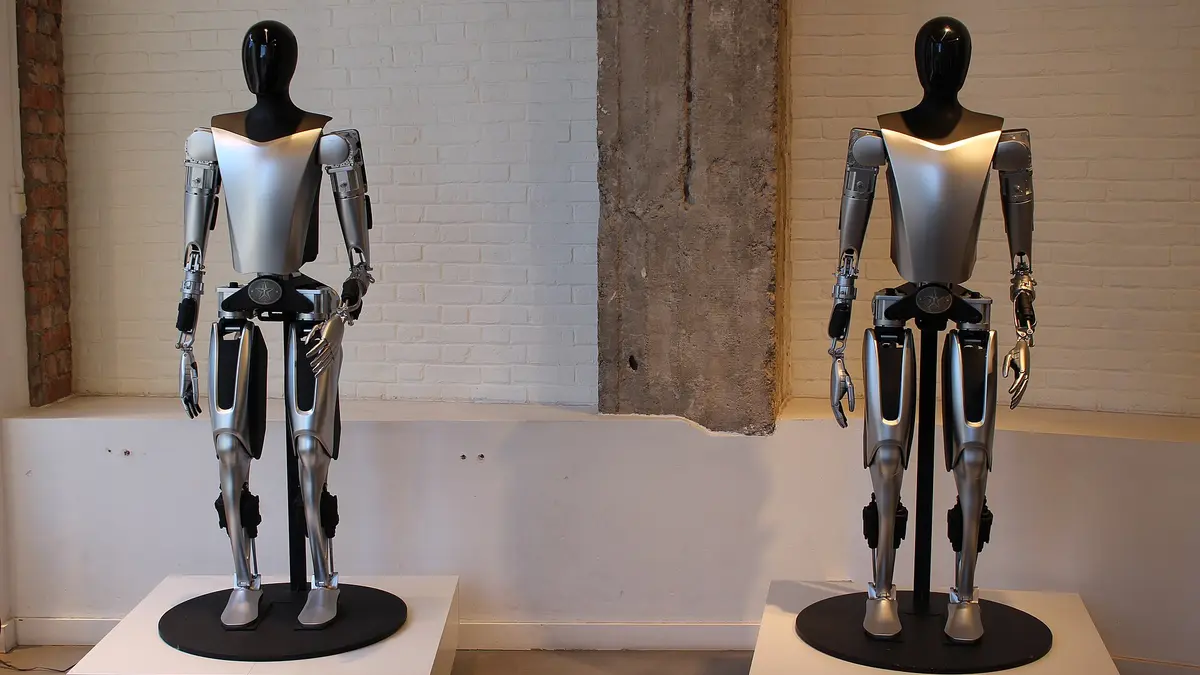
Tesla is the company betting most heavily in public on humanoids. In its third-quarter 2026 update, it said production of its Optimus robot had begun on high-volume lines in Fremont, California, and that these were the first production-quality robots it had made. It said it had proven its manufacturing process was suitable for a commercial product, while it would keep refining the hardware. It lists the Fremont operation as being in early ramp-up, with a plant in Texas under construction.
Tesla has not published figures on how many Optimus robots it has made or what they do.
The industry’s own verdict
The International Federation of Robotics represents the companies that make factory robots, so it has an interest in automation. Its 2026 report is nevertheless cautious about humanoids. It says most humanoids “remain prototypes or pilot-stage technologies rather than industrial-grade products”. It concludes that, with today’s technology, conventional industrial robots are economically superior for production tasks.
The federation expects humanoids may eventually complement existing machines in selected jobs, but says wider use in industry depends on substantial improvements in four areas:
- Reliability, so they work for long periods without breaking down.
- Safety, especially when working near people.
- Operating time, meaning how long they can work before they must stop.
- Economic viability, meaning they must earn back what they cost.
What to watch
- The share going to real work. If manufacturing and logistics grow from under a fifth of shipments, humanoids are earning their keep.
- Full-shift operation. Results showing robots working long shifts reliably would answer one of the biggest doubts.
- Published costs. Few makers disclose what customers pay or what a robot costs to run. Without those figures, claims about economic value are hard to check.
- Independent results. Most evidence still comes from manufacturers and their customers. Studies by outsiders would carry more weight.
Humanoid robots are improving quickly, and the BMW trial shows they can do real, if narrow, work. For now they remain an experiment that a few large companies can afford to run, not a replacement for the machines already on factory floors.
References and sources
- 01Global Humanoid Robot Shipments Soar Nearly 300% YoY in H1 2026, Driven by Commercial Deployments · Counterpoint Research · 20 August 2026
- 02BMW Group to deploy humanoid robots in production in Germany for the first time · BMW Group · 27 February 2026
- 03Tesla Q3 2026 update · Tesla, filed with the US Securities and Exchange Commission · 21 October 2026
- 04Executive Summary, World Robotics 2026: Industrial Robots · International Federation of Robotics · September 2026
- 05Lead image: StockholmOptimus01.jpg · Ulkl, via Wikimedia Commons (public domain) · Accessed 13 November 2026
House byline
Articles under this byline are researched and drafted with AI assistance, with every figure checked against its source before publication. The editor, Pankaj Guleria, reviews them and corrects them where needed.
Edited by Pankaj Guleria, Founder and Editor