Contents
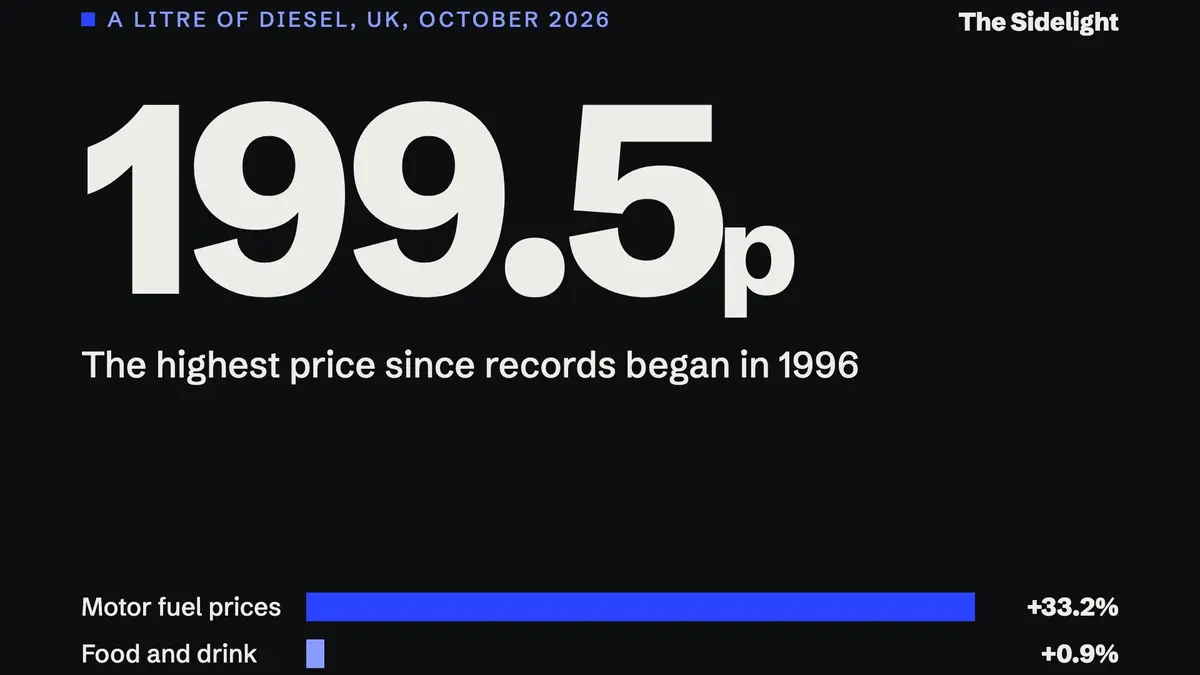
199.5p. That’s what a litre of diesel cost in the UK in October, on average. It’s the highest price the Office for National Statistics has recorded since it started tracking diesel in 1996.
It’s also the main reason UK inflation rose again. Prices were 3.6% higher than a year earlier in October, up from 3.5% in September, the ONS said on 18 November.
But here’s the thing most of the headlines miss. Strip out the forecourt, and prices are behaving much better than that 3.6% suggests. October was really two inflations at once.
This article is general information, not personal financial advice.
The short answer
UK inflation is 3.6% on the main CPI measure. Fuel did most of the damage: motor fuel prices were 33.2% higher than a year earlier, the biggest rise since July 2022. Food and drink prices rose only 0.9%, the slowest since 2021, and core inflation, which leaves out energy and food, stayed at 2.8%.
What a fill-up costs now
Diesel rose 7.0p a litre between September and October, to 199.5p. Petrol rose 5.2p, to 174.7p, its highest since August 2022. A year earlier, the same month brought rises of just 1.2p and 0.7p.
Here’s what that means at the pump, for a typical 55-litre tank:
| Fuel | Average price per litre | A full 55-litre tank | Extra cost since September |
|---|---|---|---|
| Diesel | 199.5p | £109.73 | £3.85 |
| Petrol | 174.7p | £96.09 | £2.86 |
That’s one month’s rise. Over the year, motor fuel prices went up by a third. Transport as a whole contributed more to the annual inflation rate than any other part of the shopping basket, 1.06 percentage points of the 3.6%.
Your food shop is the opposite story
Now look at the supermarket. Food and non-alcoholic drinks were only 0.9% dearer than a year earlier, down from 1.3% in September. The last time that rate was lower was September 2021. Chocolate even got cheaper, falling 2.9% in a single month.
Put simply: if you mostly notice prices at the till, inflation may not feel like 3.6%. If you drive a lot for work, it probably feels a lot worse.
| Item | % change over 12 months |
|---|---|
| Motor fuels | 33.2% |
| Transport overall | 7.5% |
| Alcohol and tobacco | 4.5% |
| All items (CPI) | 3.6% |
| Core CPI | 2.8% |
| Food and non-alcoholic drinks | 0.9% |
Core CPI leaves out energy, food, alcohol and tobacco.Source: Office for National Statistics. Chart: The Sidelight.
What’s underneath the headline
A few other things moved, and they tell you whether this is a fuel blip or something broader.
- Core inflation held at 2.8%. That’s the measure economists watch for the underlying trend, and it barely moved.
- Services inflation stayed at 3.7%. Service prices depend heavily on wages, so the Bank of England watches this one closely.
- Goods inflation jumped to 3.5%, from 3.2%, its highest since September 2023, largely because of fuel.
- Tobacco rose 5.2% in a month, which the ONS says may reflect the tobacco duty increase on 1 October.
- Hotels got cheaper, falling 3.8% in the month, which helped pull the rate down.
So far, then, this looks more like an energy problem than prices taking off across the board. That could change if high fuel costs start feeding into the price of everything that has to be driven somewhere.
What it means for your money
A typical basket of shopping that cost £100 a year ago now costs about £103.60. That’s the average; as we explain in our guide to how inflation is measured, your own rate depends on what you buy. A long commute by car means your personal inflation rate is probably well above 3.6%.
It also matters for anything that’s meant to keep up with prices. If your pay rise or your savings rate is below 3.6%, your money is buying a little less than it did a year ago.
What happens next
Two dates matter. The Bank of England makes its next decision on interest rates on 17 December; our explainer on Bank Rate sets out what that means for mortgages and savings. And the ONS publishes November’s inflation figures on 16 December, the day before.
Frequently asked questions
What is the UK inflation rate now?
3.6% on the CPI measure, in the 12 months to October 2026. On CPIH, which includes housing costs for owner occupiers, it was 3.7%.
Why did UK inflation go up in October?
Mainly fuel. Diesel rose 7.0p a litre in the month and petrol 5.2p, and transport was the biggest contributor to the annual rate. Higher tobacco prices also pushed it up, while cheaper hotel stays pulled it down.
Is food getting more expensive?
Only slowly. Food and non-alcoholic drink prices were 0.9% higher than a year earlier, the slowest rise since 2021.
When are the next UK inflation figures?
The ONS publishes figures for November on 16 December 2026.
References and sources
- 01Consumer price inflation, UK: October 2026 · Office for National Statistics · 18 November 2026
- 02What is inflation, and how is it measured in the UK? · The Sidelight · Updated 20 November 2026
- 03What is Bank Rate and how does it affect your mortgage and savings? · The Sidelight · 12 November 2026
House byline
Articles under this byline are researched and drafted with AI assistance, with every figure checked against its source before publication. The editor, Pankaj Guleria, reviews them and corrects them where needed.
Edited by Pankaj Guleria, Founder and Editor