Contents
Fusion is the process that powers the Sun. If it could be made to work in a power station it would produce electricity with no carbon emissions, from fuel that is plentiful, and without the long-lived waste of today’s nuclear plants. It has been “thirty years away” for most of the past seventy. In the last four years that has started to change, though not as much as some announcements suggest.
What fusion is
Today’s nuclear power stations use fission: they split heavy atoms such as uranium, and the split releases energy. Fusion does the reverse. It forces very light atoms together to make a heavier one, and that releases energy too.
The fuel is usually two forms of hydrogen, called deuterium and tritium. To make them fuse, they must be heated to more than a hundred million degrees, hotter than the centre of the Sun, so that they become a plasma, a gas so hot that its atoms are torn apart. The difficulty is holding something that hot in place for long enough, and getting more energy out than was put in.
There are two main ways of trying.
- Magnetic confinement. Powerful magnets hold the plasma in a ring-shaped chamber called a tokamak, away from the walls.
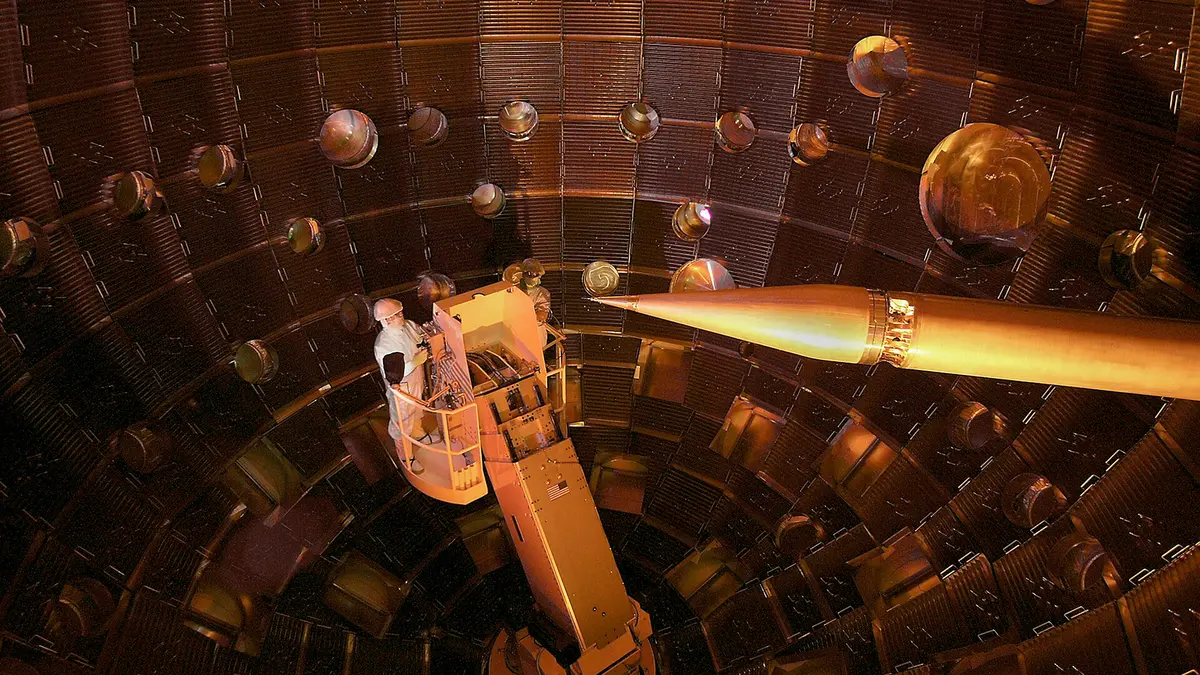
- Inertial confinement. Lasers hit a tiny capsule of fuel from all sides, crushing and heating it so fast that it fuses before it can fly apart.
The breakthrough: ignition
On 5 December 2022, the National Ignition Facility in California, part of Lawrence Livermore National Laboratory, fired its lasers at a tiny capsule of fuel. The lasers delivered 2.05 megajoules of energy to the target. The fusion reactions released 3.15 megajoules. It was the first time a controlled fusion experiment had produced more energy than was delivered to the fuel, a milestone known as ignition.
It was not a one-off. The laboratory lists eleven ignition shots up to June 2026.
| Date | Laser energy delivered | Fusion energy released |
|---|---|---|
| 5 December 2022 | 2.05 MJ | 3.15 MJ |
| 30 July 2023 | 2.05 MJ | 3.88 MJ |
| 23 February 2025 | 2.05 MJ | 5.0 MJ |
| 7 April 2025 | 2.08 MJ | 8.6 MJ |
| 20 June 2026 | Not stated | 7.9 MJ |
The record, in April 2025, released about four times the energy the lasers put in. A megajoule, or MJ, is a small amount in everyday terms. The record shot’s 8.6 megajoules is roughly the energy needed to bring 25 litres of water to the boil.
The record shot released about four times the energy the lasers delivered to the fuel.”
| Item | Megajoules, against about 2 MJ of laser energy each time |
|---|---|
| Dec 2022 | 3.15 MJ |
| Jul 2023 | 3.88 MJ |
| Feb 2025 | 5.0 MJ |
| Apr 2025 | 8.6 MJ |
| Jun 2026 | 7.9 MJ |
Source: Lawrence Livermore National Laboratory. Chart: The Sidelight.
Why that is not yet a power station
Three gaps separate these results from a working plant.
The energy accounting. The comparison is between the energy that reached the target and the energy that came out. It leaves out the much larger amount of electricity needed to run the lasers. A power station has to beat that total, with a wide margin left over to sell.
The repetition rate. The facility fires a handful of full-power shots, on carefully made targets, with long gaps between them. A power plant based on this method would need to fire several times a second, all day, on targets cheap enough to make by the million.
Turning heat into electricity. Nobody has yet built the part of a fusion plant that captures the energy, uses it to raise steam and drive a turbine, and survives the bombardment from the reaction for years.
The facility was built for weapons research and science, not to make electricity, so these were never its goals. Its result proved the physics works. The engineering is a separate job.
ITER: the giant that is running late
The largest fusion project is ITER, a tokamak being built in the south of France by Europe, China, India, Japan, South Korea, Russia and the United States. It is designed to show that a machine at power-station scale can produce far more fusion energy than is used to heat its plasma.
Its original plan had a first test in 2025. In July 2024 the project announced a new schedule, saying that date was no longer achievable.
ITER will not generate electricity even when it works. It is an experiment. A demonstration power plant would have to follow it.
The private race
While the public projects have slipped, private companies have multiplied. The Fusion Industry Association’s annual survey, reported by World Nuclear News, covered 56 companies in 2026. They raised $4.48 billion in the year to July, the most in the six years the survey has run, bringing the total to $14.24 billion.
These firms are betting that newer technology, such as stronger magnets, lets them build smaller machines faster than ITER. In the survey, 71% of companies said they expect a fusion plant to deliver power to the grid by the 2030s.
That figure deserves caution. It comes from the companies themselves, in a survey run by their trade body, and their funding depends on investors believing the timetable. The same survey names the problems they still face: funding in the short term, and beyond that materials that can withstand the reaction, power efficiency, and producing enough tritium.
Where the UK stands
The government published a fusion strategy in March 2026, backed by more than £2.5 billion over five years. Of that, £1.3 billion is for STEP, a prototype fusion power plant planned for West Burton in Nottinghamshire, on the site of a former coal-fired power station. The strategy’s nearest milestone is applying for planning consent by March 2029, which would come before main construction.
The strategy is frank about the obstacles. It calls breeding tritium “one of the greatest remaining technical challenges for fusion”. Tritium barely exists in nature, so a fusion plant must make its own fuel as it runs, something that has not been shown at scale.
So how close is it?
The honest answer has three parts.
- The physics is proven. Fusion can release more energy than is delivered to the fuel, and the results have been repeated and improved.
- The engineering is not. No machine has produced net electricity, run continuously, bred its own fuel or shown that its materials last.
- The timetables are optimistic. The best-funded public project has slipped by years, and the private forecasts come from those with most to gain from them.
Fusion is unlikely to help meet climate targets for the 2030s, which will have to be met with technologies that already exist. Whether it becomes a practical source of power later in the century depends on problems that money and time may solve, but have not yet.
References and sources
- 01Achieving fusion ignition · Lawrence Livermore National Laboratory · Accessed 12 November 2026
- 02ITER baseline press conference summary · ITER Organization · July 2024
- 03Fusion industry raised USD4.5 billion in past year, report says · World Nuclear News · 14 July 2026
- 04A new energy revolution: the UK’s plan for delivering fusion energy · Department for Energy Security and Net Zero · 16 March 2026
- 05Lead image: NIF target chamber 2.jpg · Lawrence Livermore National Laboratory, via Wikimedia Commons (public domain) · Accessed 13 November 2026
House byline
Articles under this byline are researched and drafted with AI assistance, with every figure checked against its source before publication. The editor, Pankaj Guleria, reviews them and corrects them where needed.
Edited by Pankaj Guleria, Founder and Editor