Contents
In 1975 a solar panel cost about $132 for every watt it could produce, measured in today’s money. In 2025 the figure was 12 cents. Few technologies have ever fallen in price so far or for so long, and the result is reshaping how the world makes electricity.
The short answer
Yes, and they have been for fifty years. A solar panel cost about $132 per watt in 1975 in today’s money, and about 12 cents in 2025. Prices fell about 95% between 2010 and 2025 alone. But panels are now a small part of the cost of solar power, so cheaper panels no longer mean much cheaper electricity: the average cost of power from new solar farms rose 0.6% in 2024 and stayed flat in 2025, IRENA reported.
How far prices have fallen
The longest record comes from Our World in Data, which combines academic studies with figures from the International Renewable Energy Agency (IRENA). It tracks the price of the panel itself, called a module, in constant 2025 US dollars per watt.
| Year | Price per watt |
|---|---|
| 1975 | $132.38 |
| 2000 | $6.50 |
| 2010 | $2.51 |
| 2020 | $0.32 |
| 2025 | $0.12 |
That is a fall of 99.9% over fifty years. The decline has not slowed with age. Prices dropped by about 95% between 2010 and 2025 alone.
| Item | US dollars per watt, in 2025 prices |
|---|---|
| 1975 | $132.38 |
| 2000 | $6.50 |
| 2010 | $2.51 |
| 2020 | $0.32 |
| 2025 | $0.12 |
Source: Our World in Data, from IRENA, Nemet, and Farmer and Lafond. Chart: The Sidelight.
Why it keeps getting cheaper
Solar panels are manufactured goods, more like televisions than power stations. A power station is a one-off construction project. Panels come off production lines in their millions, and each doubling of the total ever made has brought a roughly predictable fall in cost. Economists call this a learning curve.
Several things drive it:
- Scale. Bigger factories spread fixed costs over more panels.
- Better manufacturing. Thinner silicon wafers, less waste and faster production lines.
- Higher efficiency. Each panel turns more of the sunlight that hits it into electricity, so fewer panels are needed for the same output.
- Competition. Many manufacturers, most of them in China, compete hard on price.
Because demand grew every time the price fell, and each rise in demand cut the price again, the process has fed itself for decades.
What the electricity costs
A panel’s price is only part of the bill. A solar farm also needs land, mounting frames, inverters to convert the current, cables, a grid connection and finance. The measure that takes all of this into account is the levelised cost of electricity, the average cost of each unit of power over a plant’s lifetime.
IRENA’s annual cost report and its accompanying press release put the global average for new large-scale solar farms in 2024 at $0.043 per kilowatt-hour, about 41% below the cheapest new fossil fuel option. Across all renewables, 91% of the new large-scale capacity that started up in 2024 produced power more cheaply than the cheapest new fossil fuel alternative. Counting all renewables in operation, the agency estimates they avoided up to $467 billion of fossil fuel costs that year.
91% of new large-scale renewable capacity in 2024 produced power more cheaply than the cheapest new fossil fuel alternative.”
One detail in the same report deserves attention. The average cost of solar electricity rose slightly in 2024, by 0.6%, even as panels got cheaper. Panels are now such a small share of the total that other costs decide the price of solar power.
IRENA’s report on 2025 found the same pattern again. The cost of installing solar fell by around 6%, yet the average cost of its electricity stayed at $0.044 per kilowatt-hour, because higher borrowing costs cancelled out the cheaper equipment. More than 90% of new large-scale renewable projects that year were still cheaper than the lowest-cost new fossil fuel alternative.
What cheap solar has done
The International Energy Agency’s Global Energy Review 2026 shows the effect. In 2025:
- solar generation rose by 600 terawatt-hours, the largest increase of any source
- that rise alone met around 70% of the growth in world electricity generation
- solar met more than 25% of the growth in total energy demand, more than any other source
- the world added a record 800 gigawatts of renewable capacity, 75% of it solar
- renewables combined came close to matching coal’s share of world electricity
Why cheap panels are not the whole answer
Solar has a limit that no factory can fix: it produces nothing at night and little on dark winter days. As its share of the grid grows, three costs matter more than the panels.
Storage and flexibility. Power made at midday has to be stored or used at midday. Batteries have fallen in price too, but a grid with a lot of solar needs many of them, along with customers willing to shift when they use power.
Grids. New solar farms need connections, and many countries have long queues. IRENA lists permitting delays and supply chain bottlenecks among the main obstacles to further cost falls.
Finance. A solar farm costs almost nothing to run, so nearly all the expense comes up front and is paid for with borrowed money. Where interest rates are high, as in many developing countries, the same panels produce much dearer electricity. IRENA names access to finance as a leading barrier.
There is also a commercial problem. When many solar farms generate at the same moment, the wholesale price of power in those hours falls, which reduces what each farm earns. Cheap to build does not always mean profitable to own.
What it means for households
For a homeowner, the falling price of panels now makes up only a small part of the cost of a rooftop system. Scaffolding, labour, the inverter and any battery make up much of the quote, and those have not fallen in the same way. Whether panels pay for themselves depends on your roof, how much power you use during the day, and what you are paid for electricity you export. It is worth getting several quotes and checking the assumptions behind any payback figure.
The larger effect reaches everyone through the grid. For most of the new large-scale capacity the world builds, renewables are now the cheaper choice, and solar is the largest part of that.
Frequently asked questions
Are solar panels still getting cheaper?
Yes. The average module price kept falling through 2025, to about 12 cents per watt. For decades, every doubling in the number of panels ever made has brought a fairly predictable fall in cost, though that pattern is a history, not a guarantee.
When will solar get cheaper still?
Slowly, from here. IRENA expects the cost of installing solar to fall by around 40% over the next decade, roughly half the fall seen since 2010. Borrowing costs now matter as much as equipment prices, so where a solar farm is built makes a big difference.
How much have solar panel prices fallen over time?
From about $132 per watt in 1975 to $6.50 in 2000, $2.51 in 2010, $0.32 in 2020 and $0.12 in 2025, all in 2025 dollars. That is a fall of 99.9%.
Why hasn’t the cost of a home solar system fallen as much?
Because the panels are now only a small part of the bill. Scaffolding, labour, the inverter and any battery make up much of a rooftop quote, and those costs haven’t fallen the same way.
How cheap is solar electricity?
New large solar farms produced power for a global average of $0.043 per kilowatt-hour in 2024, about 41% below the cheapest new fossil fuel option, according to IRENA.
References and sources
- 01Solar photovoltaic module price · Our World in Data, from IRENA, Nemet, and Farmer and Lafond · Accessed 12 November 2026
- 0291% of New Renewable Projects Now Cheaper Than Fossil Fuels Alternatives · International Renewable Energy Agency (IRENA) · 22 July 2025
- 03Renewable Power Generation Costs in 2024 · International Renewable Energy Agency (IRENA) · July 2025
- 04Global Energy Review 2026: key findings · International Energy Agency · 2026
- 05Renewable power generation costs in 2025: Executive summary · International Renewable Energy Agency (IRENA) · July 2026
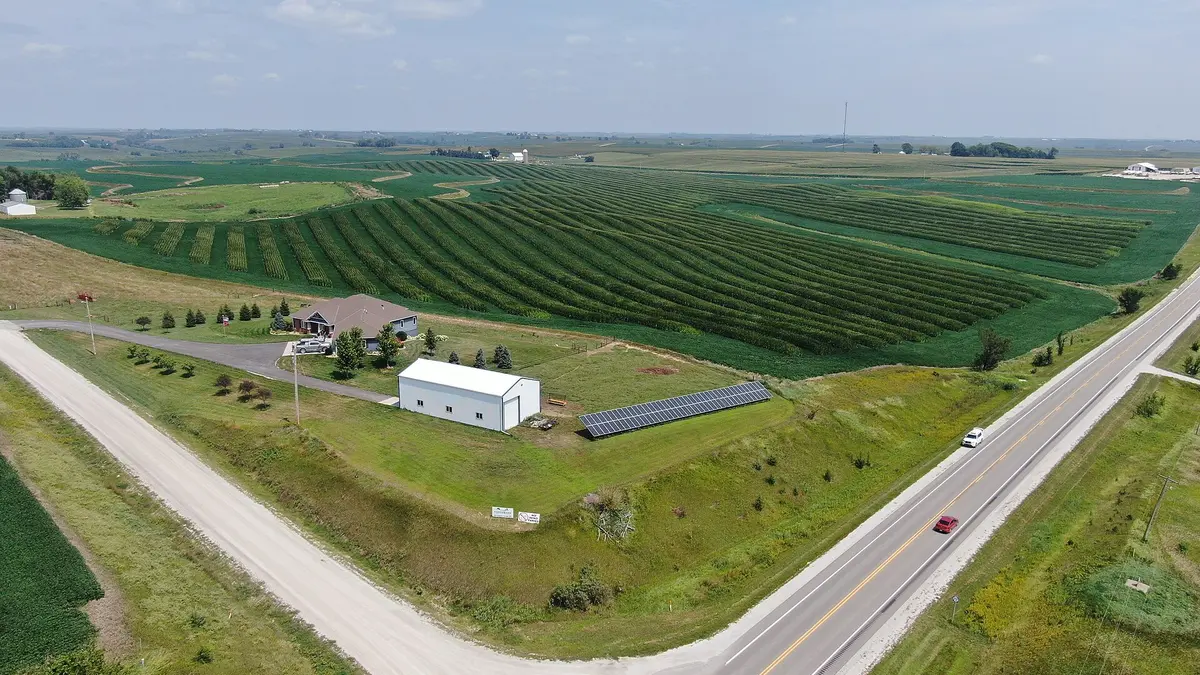
- 06Lead image: Photovoltaic Panels Reap Solar Energy on Farms (20240809-USDA-RD-DCK-0324).jpg · David Kosling, US Department of Agriculture, via Wikimedia Commons (public domain) · Accessed 13 November 2026
House byline
Articles under this byline are researched and drafted with AI assistance, with every figure checked against its source before publication. The editor, Pankaj Guleria, reviews them and corrects them where needed.
Edited by Pankaj Guleria, Founder and Editor