Contents
CRISPR is a way of changing DNA, the chemical code inside living cells that carries the instructions for building and running an organism. It lets scientists find one precise place in that code and cut it. In just over a decade it has gone from a discovery about bacteria to a medicine that the NHS provides.
This article explains the science and the evidence. It is not medical advice.
Where CRISPR came from
CRISPR was not invented from nothing. It was found in bacteria, which use it to defend themselves against viruses. A bacterium that survives an infection keeps a fragment of the virus’s genetic material as a kind of record. If the same virus returns, the bacterium uses that record to recognise the invader’s DNA and cut it apart.
Two scientists worked out how to turn that defence into a tool. The Nobel committee’s account says Emmanuelle Charpentier, studying the bacterium Streptococcus pyogenes, discovered a previously unknown molecule that was part of this ancient immune system. She began working with the biochemist Jennifer Doudna in 2011. Together they recreated the bacterial “genetic scissors” in a test tube, simplified them, and then showed they could be reprogrammed to cut any DNA molecule at a chosen site. They published in 2012 and shared the Nobel Prize in Chemistry in 2020.
How it works
The system has two parts.
- A guide. A short strand of RNA, a chemical cousin of DNA, whose sequence matches the stretch of DNA the scientist wants to change. It leads the system to the right place.
- A cutter. A protein called Cas9, which cuts both strands of the DNA at that spot.
Once the DNA is cut, the cell tries to repair it. Scientists use that repair process to switch a gene off or to change its sequence. The important advance was speed and simplicity. Changing a gene used to be slow and sometimes impossible. The Nobel committee said that with CRISPR it became possible “to change the code of life over the course of a few weeks”. To aim at a different gene, a researcher only has to write a different guide.
The first CRISPR medicine
The first treatment to reach patients targets two inherited blood disorders. In sickle cell disease, red blood cells become rigid and curved, block small blood vessels and cause episodes of severe pain. In beta thalassaemia, the body cannot make enough haemoglobin, the protein that carries oxygen, and many patients need regular blood transfusions for life.
On 16 November 2023 the UK’s medicines regulator announced it had authorised Casgevy for patients aged 12 and over with either condition. It described Casgevy as the first medicine to be licensed that uses CRISPR. The United States followed on 8 December 2023.
The treatment is done outside the body. Blood stem cells are taken from the patient’s bone marrow and edited in a laboratory. The patient is given a conditioning treatment to clear the existing bone marrow, and the edited cells are infused back. According to the US regulator, the edited cells settle in the bone marrow and increase production of fetal haemoglobin, a form the body normally stops making after infancy. Higher levels of it prevent red blood cells from sickling.
| Condition | Result |
|---|---|
| Sickle cell disease | 28 of 29 eligible patients were free of severe pain crises for at least 12 months |
| Beta thalassaemia | 39 of 42 eligible patients needed no red blood cell transfusions for at least 12 months |
The regulator reported side effects including nausea, fatigue, fever and a higher risk of infection, similar to those of a stem cell transplant using a patient’s own cells. The trials were small and the follow-up short, so how long the benefit lasts is still being measured.
Eleven years separated the paper describing CRISPR as a tool and the first licensed medicine based on it.”
| Item | % of eligible patients, for at least 12 months |
|---|---|
| Sickle cell: no severe pain crises | 28 of 29 (97%) |
| Beta thalassaemia: no transfusions | 39 of 42 (93%) |
Source: Medicines and Healthcare products Regulatory Agency. Chart: The Sidelight.
What it costs
A licence does not put a medicine on the NHS. That takes a second decision, on whether it is worth the price. The National Institute for Health and Care Excellence (NICE) first rejected Casgevy for sickle cell disease in draft guidance, then approved it for the NHS in England at the end of January 2025. The Pharmaceutical Journal reported a list price of £1,651,000 for a course. The NHS pays a confidential lower price.
The approval came through a managed access scheme, in which a treatment is funded while more evidence is collected. Eligibility is limited to people aged 12 and over who have recurrent pain crises and particular genetic forms of the disease. About 14,000 people in the UK have sickle cell disease.
The cost reflects the process as much as the science. Each treatment is made from one patient’s own cells and requires a stay in hospital.
A treatment made for one baby
The newest development removes the laboratory step. In 2025, doctors at the Children’s Hospital of Philadelphia and the University of Pennsylvania treated an infant known as KJ, who was born with severe CPS1 deficiency. In this rare disorder the liver cannot clear ammonia from the blood, and it builds up to toxic levels.
His treatment was designed for his own genetic fault. It used base editing, and was delivered into his body in tiny fat particles that carry it to the liver. The team went from identifying his variant to making the treatment in under six months. He received his first dose in February 2025, at about six to seven months old, and two more by April.
By April he had no serious side effects, could tolerate more protein in his diet and needed less medication. The researchers were careful about what this shows. He is one patient, they said longer follow-up is needed to judge the benefit, and he will need monitoring for life. The results were published in the New England Journal of Medicine.
The limits and the ethics
- Getting it to the right cells. Blood stem cells can be removed and edited, and the liver readily absorbs the particles used for KJ. Reaching the brain, heart or muscles is much harder.
- Unintended edits. The system can occasionally cut or change DNA in the wrong place. Each new treatment has to be tested for this.
- Cost and access. A one-off treatment priced in the millions will reach few patients, particularly in the countries in Africa and South Asia where sickle cell disease is most common.
- Inherited changes. Every treatment described here alters cells in one patient, and the change is not passed on to their children. Editing embryos, eggs or sperm would be inherited by future generations. That is a different matter, and it is restricted or banned in many countries.
CRISPR has proved that editing human genes can treat disease. The questions now are how many conditions it can reach, how long the benefits last, and who will be able to afford it.
References and sources
- 01Press release: The Nobel Prize in Chemistry 2020 · The Royal Swedish Academy of Sciences · 7 October 2020
- 02MHRA authorises world-first gene therapy that aims to cure sickle-cell disease and transfusion-dependent β-thalassemia · Medicines and Healthcare products Regulatory Agency · 16 November 2023
- 03FDA approves first gene therapies to treat patients with sickle cell disease · US Food and Drug Administration · 8 December 2023
- 04NICE approves gene-editing sickle cell therapy for NHS in England · The Pharmaceutical Journal · 4 February 2025
- 05World’s first patient treated with personalized CRISPR gene editing therapy at Children’s Hospital of Philadelphia · Penn Today, University of Pennsylvania · 14 May 2025
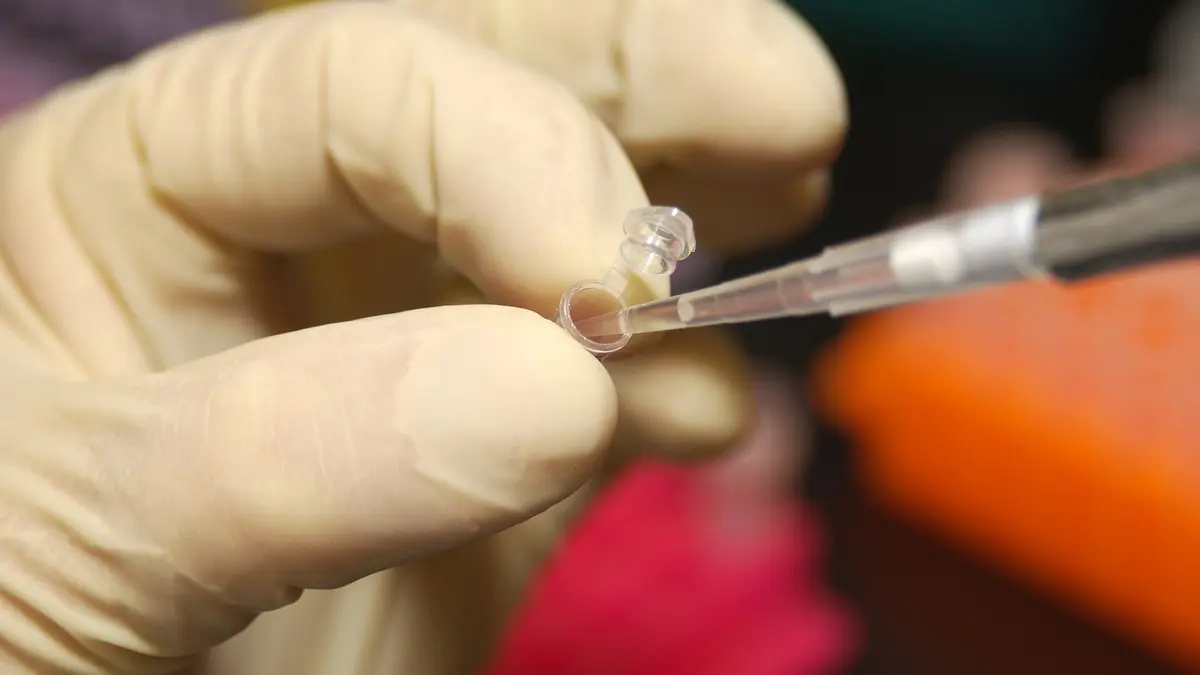
- 06Lead image: NHGRI researcher uses a pipette to remove DNA from a micro test tube.jpg · Maggie Bartlett, National Human Genome Research Institute, via Wikimedia Commons (public domain) · Accessed 13 November 2026
House byline
Articles under this byline are researched and drafted with AI assistance, with every figure checked against its source before publication. The editor, Pankaj Guleria, reviews them and corrects them where needed.
Edited by Pankaj Guleria, Founder and Editor