Contents
Most of the work inside a living cell is done by proteins. What a protein does depends on its shape, and for half a century scientists could not reliably work out that shape without months or years of laboratory work. AlphaFold, an artificial intelligence system built by Google DeepMind in London, changed that. In 2024 it earned its creators a Nobel prize.
The problem it solved
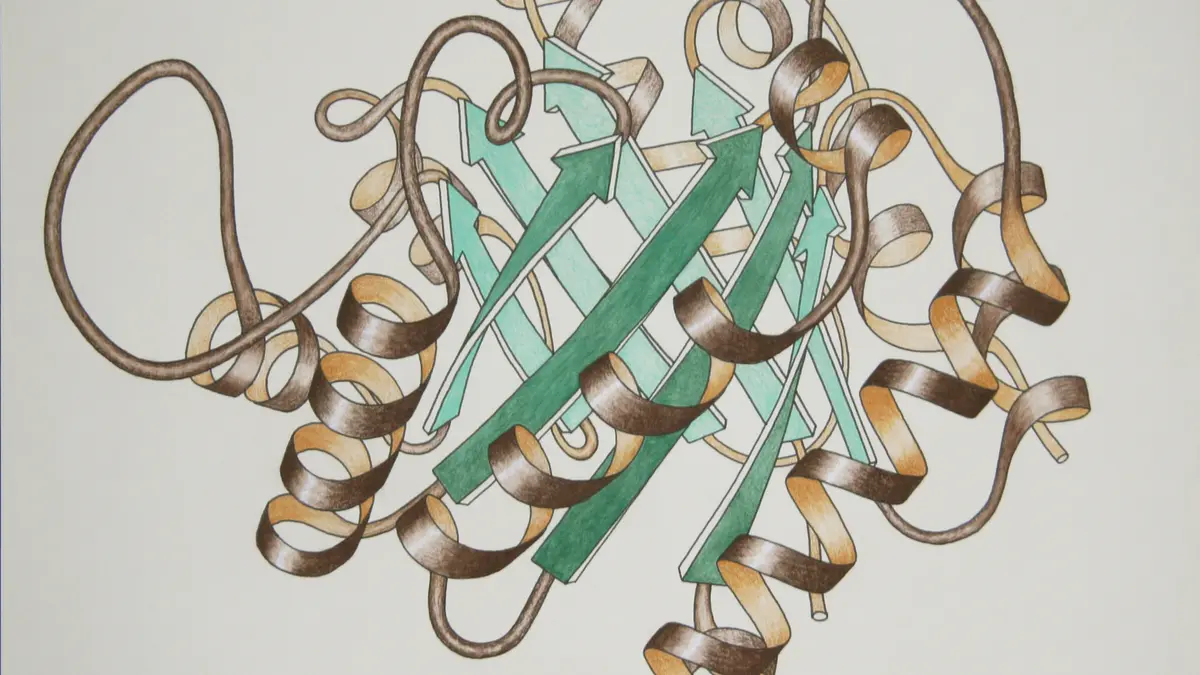
A protein is a chain of smaller units called amino acids. There are 20 kinds, and a protein may contain anything from a few dozen to several thousand of them, strung together in a set order. The chain does not stay straight. It folds into a three-dimensional structure, and that structure decides what the protein can do: carry oxygen, fight an infection, digest food or copy DNA.
The order of the amino acids is easy to read from an organism’s genes. The shape is not. The Nobel committee notes that since the 1970s researchers had tried to predict protein structures from amino acid sequences, and found it “notoriously difficult”. The alternative was to determine each structure by experiment, using techniques such as firing X-rays at crystallised protein. That works, but it is slow and expensive, and it fails for many proteins.
This was known as the protein folding problem. Knowing a protein’s structure helps scientists understand how it works, what goes wrong in disease, and how a drug might attach to it.
What AlphaFold does
AlphaFold takes the sequence of amino acids as its input and returns a predicted 3D structure. It is a machine-learning system, meaning it was not given the rules of chemistry to follow step by step. It was trained on the structures that scientists had already worked out by experiment, and learned the patterns linking sequence to shape.
The breakthrough version, AlphaFold2, was presented in 2020. The team entered it in CASP14, a long-running competition in which research groups predict structures that have been solved by experiment but not yet published. According to the database’s own account, it was the top-ranked method “by a large margin” and regularly achieves accuracy competitive with experiment.
The free database
DeepMind then did something that mattered as much as the science. Working with EMBL’s European Bioinformatics Institute, based near Cambridge, it ran AlphaFold on the known proteins of the living world and published the results. The Nobel committee says the team was able to predict the structure of “virtually all the 200 million proteins that researchers have identified”.
The AlphaFold Protein Structure Database now says it offers more than 260 million predictions. They are free for academic and commercial use, provided the source is credited. A researcher who once might have spent years determining one structure can look it up in seconds.
A researcher who once might have spent years determining one structure can look it up in seconds.”
| Item | Millions |
|---|---|
| Database today | More than 260m |
| Nobel committee, October 2024 | About 200m |
Source: Nobel committee; AlphaFold Protein Structure Database. Chart: The Sidelight.
The Nobel prize
The 2024 Nobel Prize in Chemistry was announced on 9 October 2024 and split in two.
One half went jointly to Demis Hassabis and John Jumper of Google DeepMind “for protein structure prediction”. The committee said they had developed an AI model to solve a 50-year-old problem.
The other half went to David Baker of the University of Washington “for computational protein design”. His work runs in the opposite direction. Instead of predicting the shape of proteins that exist in nature, he designs new ones. In 2003 his group built a protein unlike any known one, and it has since produced proteins for use as medicines, vaccines, nanomaterials and sensors.
Among the uses of AlphaFold the committee picked out were understanding how bacteria resist antibiotics and picturing enzymes that can break down plastic.
What came next
In May 2024 DeepMind and its sister company Isomorphic Labs announced AlphaFold 3. Earlier versions dealt with proteins. The new one also predicts the structures of DNA, RNA and ligands, and how these molecules fit together. That matters for medicine, because a drug works by attaching to its target.
The company claimed an improvement of at least 50% over existing methods at predicting how proteins interact with other kinds of molecule, and a doubling of accuracy for some types of interaction. Those are the developers’ own figures. Scientists can use most of its features through a free online tool, the AlphaFold Server, for non-commercial research. Isomorphic Labs uses the model in its own drug design work and with pharmaceutical companies.
What AlphaFold cannot do
The achievement is real, and it is also narrower than some headlines suggest.
- A prediction is not an observation. AlphaFold’s output is a calculated best estimate. Each prediction comes with a confidence score, and some parts of some proteins are predicted poorly. Important results still need checking by experiment.
- Proteins move. A protein in a cell is not a rigid object. Many change shape as they work, and some have regions with no fixed shape at all. A single predicted structure is a snapshot.
- A structure is not a drug. Knowing the shape of a target is an early step in a long process. A candidate medicine still has to be designed, made, and tested for safety and effect in animals and people, which takes years and usually fails.
- It learned from experiments. AlphaFold was trained on decades of structures painstakingly determined in laboratories and shared in public databases. It depends on that work and does not replace it.
Why it matters beyond biology
AlphaFold is often cited as the clearest case so far of artificial intelligence producing a scientific result that people had tried and failed to reach by other means. It did so on a problem with a precise question, a large body of high-quality data and a way to check the answer. Those conditions are less common than the excitement around AI in science suggests, and they are a useful test to apply to the next claimed breakthrough.
References and sources
- 01Press release: The Nobel Prize in Chemistry 2024 · The Royal Swedish Academy of Sciences · 9 October 2024
- 02AlphaFold Protein Structure Database · Google DeepMind and EMBL’s European Bioinformatics Institute · Accessed 12 November 2026
- 03AlphaFold 3 predicts the structure and interactions of all of life’s molecules · Google · 8 May 2024
- 04Lead image: TriosePhosphateIsomerase Ribbon pastel photo.png · Jane Richardson, via Wikimedia Commons (CC BY 3.0) · Accessed 13 November 2026
House byline
Articles under this byline are researched and drafted with AI assistance, with every figure checked against its source before publication. The editor, Pankaj Guleria, reviews them and corrects them where needed.
Edited by Pankaj Guleria, Founder and Editor