
Contents
The energy price cap is about to change, and you’ll hear it described as a cap on bills. It isn’t. Ofgem, which sets it, says so in plain words: it “does not limit the cost of your total bill”.
What it limits is the price of each unit of energy and the fixed daily charge. Use more, and you pay more, with no ceiling at all.
That matters this week. Ofgem announces the cap for January to March by 25 November, and forecasters expect a rise. Here’s how to turn whatever number it announces into what it means for your home.
This article is general information, not personal financial advice.
The short answer
The price cap sets the most a supplier can charge on a standard variable tariff for two things: each kilowatt hour (kWh) of gas or electricity you use, and a standing charge you pay every day. Your total bill depends on how much energy you use. If you’re on a fixed tariff, the cap doesn’t apply to you at all.
The two numbers that make up your bill
Every gas and electricity bill on a standard tariff is built from two parts:
- The unit rate. A price for each kWh you use. More heating, more washing, more kWh.
- The standing charge. A fixed amount per day, whether you use any energy or not. It pays for things like the pipes and wires that reach your home.
The cap limits both. For 1 October to 31 December 2026, the averages for someone paying by Direct Debit are:
| Fuel | Unit rate | Daily standing charge |
|---|---|---|
| Electricity | 26.32p per kWh | 54.83p |
| Gas | 7.97p per kWh | 29.68p |
Two details from Ofgem’s announcement: the government has removed VAT from electricity bills from 1 October 2026 to 31 March 2027, so the electricity figures include no VAT. Gas still has 5% VAT, which is included. And these are averages across England, Scotland and Wales: your region’s rates will be a little different.
What it means in pounds
Here’s the bit the headlines skip. Take the standing charges on their own:
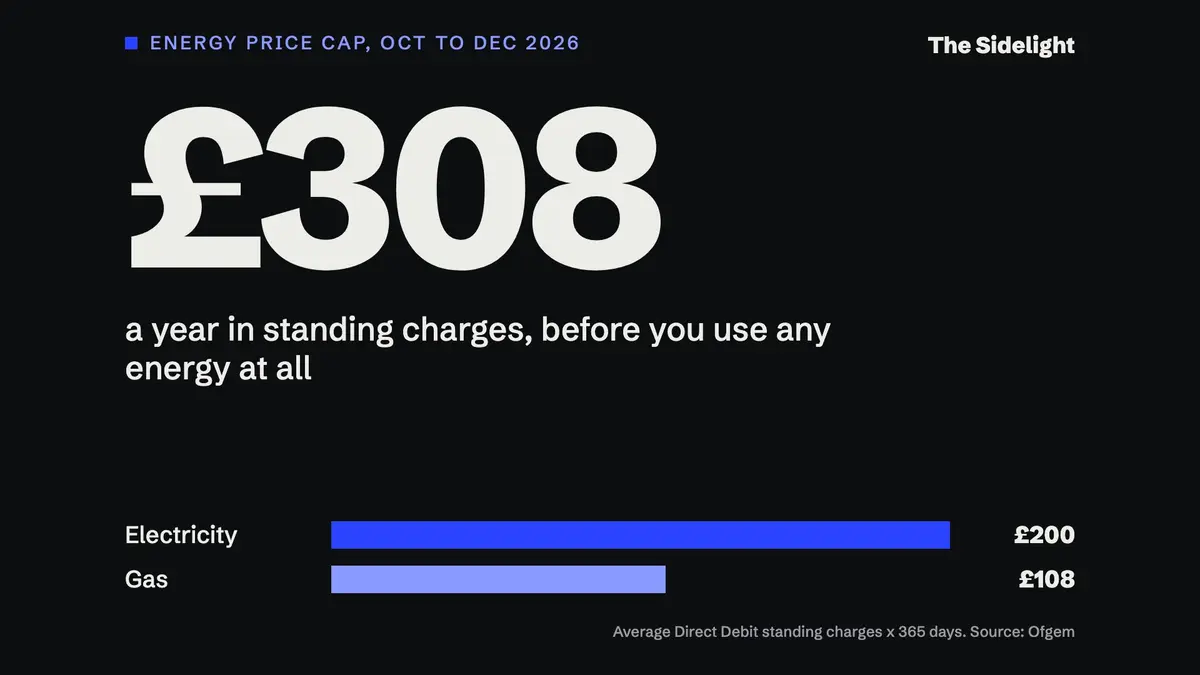
- Electricity: 54.83p a day is about £200 a year.
- Gas: 29.68p a day is about £108 a year.
That’s roughly £308 a year before you boil a kettle. If you used no energy at all, you’d still pay it.
Now the part you control. These examples use the current average rates and a 30-day month, and they’re illustrations, not typical bills:
| Example | Energy used | Unit cost | Standing charge | Total |
|---|---|---|---|---|
| Electricity, a smaller flat | 150 kWh | £39.48 | £16.45 | £55.93 |
| Electricity, a family home | 300 kWh | £78.96 | £16.45 | £95.41 |
| Gas, a mild month | 500 kWh | £39.85 | £8.90 | £48.75 |
| Gas, a cold winter month | 1,500 kWh | £119.55 | £8.90 | £128.45 |
See what happens when gas use triples in a cold month: the bill goes from £48.75 to £128.45. The cap didn’t stop that, and it was never meant to.
| Item | £ per 30-day month |
|---|---|
| 500 kWh | £48.75 |
| 1,000 kWh | £88.60 |
| 1,500 kWh | £128.45 |
| 2,000 kWh | £168.30 |
Our calculation from Ofgem’s average Direct Debit gas rates: 7.97p per kWh and a 29.68p daily standing charge, over 30 days.Source: Ofgem. Chart: The Sidelight.
The cap limits the price of each unit. It doesn’t limit how many units you use, so it can’t limit your bill.”
Who the cap covers, and who it doesn’t
According to Ofgem, the cap protects people on standard variable tariffs, which are the default tariffs whose price can go up or down. That includes people who pay by Direct Debit, on receipt of a bill, or with a prepayment meter.
You’re not covered if you:
- agreed a fixed tariff with your supplier
- have a business energy contract
- get your heat from a heat network or use heating oil
How to read the new cap on 25 November
When the January figure is announced, you’ll mostly hear one number: a “typical” yearly bill, and how much it has gone up. That’s useful for headlines, but it’s based on a typical amount of energy use, not yours.
To work out what it means for you:
- Find your own usage. Your bill or app shows how many kWh you used last year, or last January.
- Look at the new unit rates, not just the typical bill. Multiply your kWh by the new rate.
- Add the standing charges for the days in the period.
- Check if you’re on a fixed deal. If you are, the new cap doesn’t change your prices until the deal ends.
We’ll update this piece with the new rates once Ofgem publishes them.
Frequently asked questions
Does the energy price cap limit my bill?
No. It limits the price per kWh and the daily standing charge on standard variable tariffs. Ofgem says it does not limit the cost of your total bill, which depends on how much energy you use.
What is the energy price cap now?
From 1 October to 31 December 2026, the average cap for Direct Debit customers is 26.32p per kWh of electricity with a 54.83p daily standing charge, and 7.97p per kWh of gas with a 29.68p daily standing charge.
When is the next price cap announced?
Ofgem will announce the cap for 1 January to 31 March 2027 on or before 25 November 2026.
Does the price cap apply to fixed tariffs?
No. If you’ve agreed a fixed tariff, your prices are set by that deal, not by the cap.
How much are standing charges a year?
At the October to December 2026 average rates, about £200 a year for electricity and £108 for gas, around £308 in total for a home with both.
References and sources
- 01Changes to energy price cap between 1 October and 31 December 2026 · Ofgem · 26 August 2026
- 02Energy price cap and standing charges explained · Ofgem · Checked 22 November 2026
- 03Energy price cap unit rates and standing charges · Ofgem · Checked 22 November 2026
House byline
Articles under this byline are researched and drafted with AI assistance, with every figure checked against its source before publication. The editor, Pankaj Guleria, reviews them and corrects them where needed.
Edited by Pankaj Guleria, Founder and Editor