
Contents
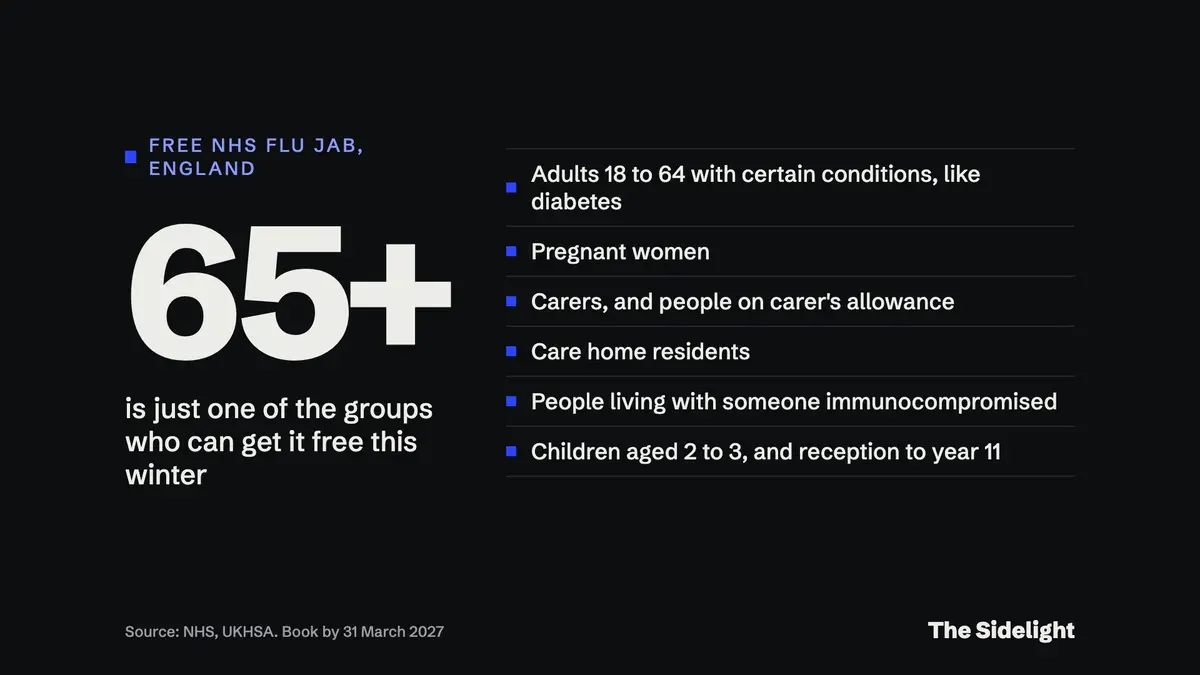
Most people know the free flu jab is for over-65s. Far fewer know how many other people qualify: if you have asthma that needs a steroid inhaler, you’re pregnant, you look after an older relative, or you have diabetes, you can very likely get it free too.
Flu can be a serious, even life-threatening illness for people in these groups, which is why the NHS offers them the vaccine every autumn and winter. Here’s the full list for England, checked against the NHS and the UK Health Security Agency.
This article is general information, not medical advice. If you’re not sure whether the vaccine is right for you, speak to your GP surgery, a pharmacist or call NHS 111.
The short answer
In England you can get a free NHS flu vaccine this winter if you’re 65 or over (or will be by 31 March 2027), aged 18 to 64 with certain long-term health conditions, pregnant, living in a care home, a main carer or on carer’s allowance, living with someone with a weakened immune system, or 16 or over and sleeping rough or in a hostel. Most children are eligible too. You can book online, in the NHS App, at a pharmacy or through your GP, until 31 March 2027.
Adults who can get it free
According to the NHS, you can get the free flu vaccine if you:
- are aged 65 or over, including people who will be 65 by 31 March 2027
- are aged 18 to 64 and have certain long-term health conditions (listed below)
- are pregnant, at any stage of pregnancy
- live in a care home
- are the main carer for an older or disabled person, or receive carer’s allowance
- live with someone who has a weakened immune system
- are aged 16 or over and sleeping rough or staying in a homeless hostel or night shelter
Frontline health and social care workers can usually get it through their employer. If you work for a registered care home, home care provider or hospice, or through direct payments, and your employer can’t offer it, the NHS says you can get it at a pharmacy or GP surgery instead.
The health conditions that count
This is the list people most often don’t realise applies to them. The NHS includes long-term conditions such as:
- breathing conditions such as asthma (if you need a steroid inhaler or tablets), COPD or cystic fibrosis
- heart conditions, such as coronary heart disease or heart failure
- chronic kidney disease
- liver disease, such as cirrhosis or hepatitis
- some conditions affecting the brain or nerves, such as Parkinson’s disease, motor neurone disease, multiple sclerosis or cerebral palsy
- a learning disability
- diabetes or Addison’s disease
- a weakened immune system, from a condition such as HIV or a treatment such as chemotherapy or steroid medicine
- problems with your spleen, such as sickle cell disease, or if your spleen has been removed
- a body mass index (BMI) of 40 or above
If you have a condition and aren’t sure whether it counts, the NHS advice is to ask your GP surgery or specialist.
If you need a steroid inhaler for asthma, have diabetes or care for an older relative, you can very likely get the flu jab free.”
Children
Children were offered the vaccine from 1 September. UKHSA says this year’s eligible groups include:
- all children aged 2 or 3 on 31 August 2026
- school-aged children from reception to year 11
- children aged 6 months to under 18 in clinical risk groups
The children’s vaccine is usually a quick nasal spray rather than an injection; children who can’t have the spray get an injection instead. Most school-aged children get it at school. For 2 and 3 year olds, you can book through your GP surgery, online, or at a pharmacy that offers the children’s vaccine.
| Group | Offered from |
|---|---|
| Pregnant women, children aged 2 or 3, school-aged children, children in risk groups | 1 September 2026 |
| Everyone aged 65 or over, adults 18 to 64 in risk groups, care home residents, carers and others | 1 October 2026 |
How to get it
If you’re eligible, the NHS says you can:
- Book online or in the NHS App.
- Find a pharmacy that offers free flu vaccination.
- Contact your GP surgery to book an appointment.
The last day to get the vaccine is 31 March 2027, and online booking closes on 30 March. But the vaccine usually takes up to 14 days to work, so the NHS recommends getting it as soon as you can.
If you live in Scotland, Wales or Northern Ireland
This guide covers England. Scotland, Wales and Northern Ireland run their own flu programmes, with similar but not identical rules. Check NHS Inform (Scotland), NHS 111 Wales or nidirect (Northern Ireland).
Frequently asked questions
Who can get a free flu jab in 2026?
In England: everyone 65 or over (or turning 65 by 31 March 2027), adults 18 to 64 with certain long-term conditions, pregnant women, care home residents, carers, people living with someone with a weakened immune system, people aged 16 or over sleeping rough or in hostels, and most children.
Can I get a free flu jab at a pharmacy?
Yes, if you’re eligible. Many pharmacies offer the free NHS flu vaccine, and the NHS website has a tool to find one near you.
Is asthma a reason to get a free flu jab?
Yes, if your asthma needs a steroid inhaler or tablets. That’s one of the long-term conditions on the NHS list.
When is the last day to get the flu jab?
31 March 2027. Online booking closes on 30 March 2027.
Can the flu jab give you flu?
No. The NHS says the injected flu vaccines used in the UK don’t contain live flu viruses, so they can’t give you flu.
References and sources
- 01Flu vaccine · NHS · Reviewed 29 September 2026
- 02Your guide to who’s eligible for the autumn 2026 flu vaccine · UK Health Security Agency · 27 August 2026
- 03National flu immunisation programme 2026 to 2027 letter · GOV.UK · Checked 22 November 2026
- 04Children’s flu vaccine · NHS · Checked 22 November 2026
- 05Book a flu vaccination · NHS · Checked 22 November 2026
- 06Find a pharmacy that offers free flu vaccination · NHS · Checked 22 November 2026
House byline
Articles under this byline are researched and drafted with AI assistance, with every figure checked against its source before publication. The editor, Pankaj Guleria, reviews them and corrects them where needed.
Edited by Pankaj Guleria, Founder and Editor