Contents
Apple, Microsoft, Alphabet, Amazon, Meta and Nvidia are often discussed as one group, “big tech”. Their accounts show six quite different businesses. Between them they reported about $2.35 trillion of revenue in their most recent financial years, and in most cases a single product line or activity produced more than half of it.
This article is general information, not personal financial advice.
The short answer, in one table
Revenue is the money a company takes in from customers before any costs are paid. Large companies must split it into segments, the main parts of the business they report on separately. The figures below come from each company’s latest annual filing or full-year results. The percentages are our calculations from those figures.
| Company | Year ended | Total revenue | Largest source | Share of total |
|---|---|---|---|---|
| Apple | September 2026 | $478.8bn | iPhone, $254.1bn | 53% |
| Microsoft | June 2026 | $331.8bn | Productivity and Business Processes, $140.0bn | 42% |
| Alphabet | December 2025 | $402.8bn | Google Search and other, $224.5bn | 56% |
| Amazon | December 2025 | $716.9bn | Online stores, $269.3bn | 38% |
| Meta | December 2025 | $201.0bn | Advertising, $196.2bn | 98% |
| Nvidia | January 2026 | $215.9bn | Data Center, $193.7bn | 90% |
The six do not share a financial year. Apple’s runs to late September and Nvidia’s to late January, so these twelve-month periods overlap but do not match.
| Item | US dollars, billions |
|---|---|
| Amazon | $716.9bn |
| Apple | $478.8bn |
| Alphabet | $402.8bn |
| Microsoft | $331.8bn |
| Nvidia | $215.9bn |
| Meta | $201.0bn |
Financial years end in different months.Source: Company annual reports and results. Chart: The Sidelight.
Apple: a phone company with a growing services arm
Apple’s annual report shows net sales of $478.8 billion. The iPhone accounted for $254.1 billion. Mac computers brought in $37.9 billion, the iPad $27.9 billion, and wearables, home devices and accessories $35.6 billion.
The second-largest line is Services, at $123.3 billion, or about 26% of sales. Apple defines this as advertising, AppleCare support plans, cloud storage, digital content such as the App Store and Apple Music, and payment services such as Apple Pay. Services matter more to profit than their share of sales suggests. Apple reported a gross margin, meaning the share of sales left after the direct cost of supplying them, of 76.2% on services and 39.3% on products.
Microsoft: software subscriptions and cloud, almost level
Microsoft reports three segments. In its results for the year to June 2026, two of them were nearly the same size:
- Productivity and Business Processes, $140.0 billion. This includes Microsoft 365, LinkedIn and Dynamics 365.
- Intelligent Cloud, $137.8 billion. This is mainly Azure, which rents computing power and storage to other organisations over the internet, a business known as cloud computing.
- More Personal Computing, $54.1 billion. This covers Windows, devices, Xbox and search advertising.
Microsoft does not publish an exact annual figure for Azure. Its chief executive, Satya Nadella, said in the release that Azure revenue “surpassed $100 billion for the first time”.
Alphabet and Meta: advertising businesses
Alphabet, Google’s parent company, states in its annual report that it earned “more than 70% of total revenues from online advertising in 2025”. Its revenue table gives the detail. Of $402.8 billion in total, adverts on Google Search and related services brought in $224.5 billion, YouTube adverts $40.4 billion, and adverts placed on partner websites through Google Network $29.8 billion. Together that is $294.7 billion, or 73%.
The remainder is growing. Google Cloud reported $58.7 billion. Subscriptions, platforms and devices, which include YouTube subscriptions, Google One, the Google Play app store and Pixel phones, brought in $48.0 billion. Other Bets, the group that includes the self-driving car company Waymo, reported $1.5 billion.
Meta is more concentrated still. Its 2025 results show advertising revenue of $196.2 billion out of $201.0 billion. Reality Labs, the division that makes its virtual and augmented reality products, had revenue of $2.2 billion and an operating loss of $19.2 billion. The advertising business is, in effect, paying for that bet.
Amazon: most sales from shopping, most profit from cloud
Amazon has the largest revenue of the six, at $716.9 billion in 2025, according to its annual report. The report breaks this down by type of sale.
Third-party seller services are the commissions and delivery fees that Amazon charges independent merchants who sell on its site. With advertising and subscriptions, they mean a large part of Amazon’s retail income is now fees, not goods it sells itself.
Revenue and profit sit in different places. AWS, the cloud computing arm, made up 18% of sales but $45.6 billion of the company’s $80.0 billion operating income, which is profit from normal business activity before interest and tax. That is 57%. The North America and International retail segments, with $588.2 billion of sales between them, earned $34.4 billion.
Revenue and profit sit in different places. AWS made up 18% of Amazon’s sales but 57% of its operating income.”
Nvidia: almost entirely data centre chips
Nvidia designs processors. In its results for the year to 25 January 2026, revenue was $215.9 billion, up 65% on the year before. Data Center, the unit selling chips and networking equipment used to train and run artificial intelligence systems, brought in $193.7 billion.
Gaming, the business Nvidia was once best known for, was $16.0 billion. Professional Visualization, which serves designers and engineers, was $3.2 billion, and Automotive and Robotics $2.3 billion.
What the numbers do and do not show
Three patterns stand out.
- Concentration is normal. Four of the six get more than half their revenue from one source. Meta and Nvidia get about nine-tenths or more.
- The companies fund each other. Microsoft, Alphabet and Amazon all sell cloud computing, and cloud providers are major buyers of data centre chips. Strong or weak demand in one place is likely to show up in the others.
- Revenue is not profit. Amazon’s shops and Apple’s services show how far a segment’s share of sales can differ from its share of earnings.
There are limits to comparing these figures. Each company chooses its own segments, and the labels are broad. Alphabet’s “Google Search and other” and Microsoft’s “Intelligent Cloud” each contain several products that are not reported separately. The financial years differ, so a company reporting to September 2026 has had more time to grow than one reporting to December 2025. And none of these filings says how much revenue comes from artificial intelligence specifically, which is the question many readers most want answered.
References and sources
- 01Form 10-K for the fiscal year ended 26 September 2026 · Apple, filed with the US Securities and Exchange Commission · November 2026
- 02Earnings release FY26 Q4 · Microsoft · 29 July 2026
- 03Form 10-K for the fiscal year ended 31 December 2025 · Alphabet, filed with the US Securities and Exchange Commission · February 2026
- 04Form 10-K for the fiscal year ended 31 December 2025 · Amazon, filed with the US Securities and Exchange Commission · February 2026
- 05Meta Reports Fourth Quarter and Full Year 2025 Results · Meta · 28 January 2026
- 06NVIDIA Announces Financial Results for Fourth Quarter and Fiscal 2026 · Nvidia · 25 February 2026
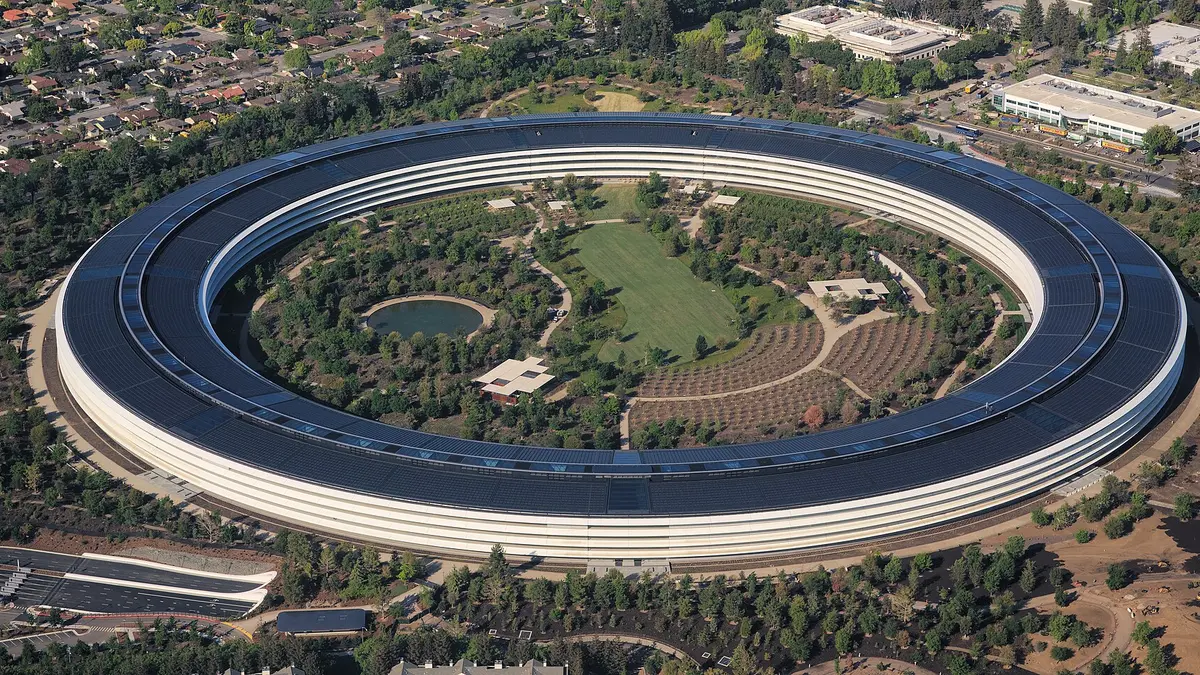
- 07Lead image: Aerial view of Apple Park dllu (cropped).jpg · Daniel L. Lu, via Wikimedia Commons (CC BY-SA 4.0) · Accessed 13 November 2026
House byline
Articles under this byline are researched and drafted with AI assistance, with every figure checked against its source before publication. The editor, Pankaj Guleria, reviews them and corrects them where needed.
Edited by Pankaj Guleria, Founder and Editor