Contents
An AI model is, at bottom, a very large set of numbers. The difference between an open model and a closed one is who is allowed to hold those numbers. That one fact decides what the model costs to use, where your data goes and who can check how it behaves.
What the weights are
A language model learns by adjusting billions of numerical values, called weights or parameters, until its output matches patterns in its training data. Once training is finished, the weights are the model. Anyone who has the file, and a powerful enough computer, can run it.
A closed or proprietary model keeps that file private. The company runs the model on its own servers and sells access through an app or an API, which is a connection that lets other software send requests and receive answers. You never see the weights.
An open-weight model is one whose maker publishes the file for download. You can run it on your own machine, with no connection to the company that built it.
Open weights are not the same as open source
In everyday use, “open” and “open source” are treated as the same thing. They are not. The Open Source Initiative (OSI), the body that maintains the standard definition of open source software, published version 1.0 of its Open Source AI Definition on 28 October 2024.
The definition says an open source AI system must give people four freedoms: to use it for any purpose without asking permission, to study how it works, to modify it and to share it. To make that possible, the maker has to release three things:
- The parameters, meaning the weights.
- The code used to train and run the system.
- Data information, meaning a description of the training data detailed enough for a skilled person to build a comparable system.
The definition does not require the training data itself to be published, only enough information about it.
Open weights cover the first item alone. The OSI’s page on open weights says that without the training code and data details, outsiders can adapt a model but cannot reproduce how it was made or easily judge the quality and bias of the data behind it.
When the OSI tested the definition against existing models, a handful of research models passed, including Pythia from EleutherAI and Google’s T5. Meta’s Llama 2, Microsoft’s Phi-2 and Mistral’s Mixtral did not. The OSI stresses that these results were not formal certifications.
The difference between an open model and a closed one is who is allowed to hold those numbers.”
The licence decides what you can do
A downloadable model still comes with a licence, and licences vary widely.
Some open-weight models use standard permissive software licences. OpenAI’s gpt-oss models are released under the Apache 2.0 licence, which grants a free, permanent right to use, modify and redistribute the work, including commercially, provided the licence and notices are passed on. DeepSeek’s R1 model card says its weights are under the MIT licence and allow commercial use and modification.
Others use licences written by the company. Meta’s Llama 3.1 Community License, dated 23 July 2024, lets most people use the model for free but adds conditions. A company whose products have more than 700 million monthly active users must ask Meta for a separate licence. Products must display “Built with Llama”, and users must follow Meta’s acceptable use policy. The OSI argues that limits like these mean Llama is not open source, whatever the marketing says. Later Llama versions have their own licences, so the terms should be checked for each release.
| Feature | Closed | Open-weight | Open source AI (OSI definition) |
|---|---|---|---|
| Weights published | No | Yes | Yes |
| Training code published | No | Not required | Yes |
| Training data described in detail | No | Not required | Yes |
| Use for any purpose | Set by the provider’s terms | Depends on the licence | Yes |
| Run on your own hardware | No | Yes | Yes |
Cost: renting versus running
Closed models are usually billed by use. Text is measured in tokens, which are fragments of words. Anthropic’s price list, for example, shows its Claude Fable 5.2 model at $8 per million tokens sent in and $40 per million tokens sent back. There is nothing to install, and the provider handles the hardware.
An open-weight model has no fee for the model itself, but the computing is your problem. OpenAI’s model card says the larger gpt-oss model fits on a single graphics processor with 80GB of memory, a data-centre class chip, while the smaller one can run in 16GB of memory.
Which is cheaper depends on volume. Light or occasional use favours paying per request. Heavy, steady use can favour owning or renting the hardware, though staff time and electricity also count.
| Item | Gigabytes of memory |
|---|---|
| gpt-oss-120b, on one graphics processor | 80GB |
| gpt-oss-20b | 16GB |
Source: OpenAI model card on Hugging Face. Chart: The Sidelight.
Privacy: where your data goes
With a closed model, every request travels to the provider’s servers. What happens to it there is governed by the provider’s terms, which differ between companies and between consumer and business products.
With an open-weight model run locally, the data need not leave your own systems. A 2024 report by the US National Telecommunications and Information Administration (NTIA) lists this among the benefits of open weights, since users can run models without sharing data with a third party. That matters for hospitals, law firms and others handling confidential material. It only holds if you run the model yourself. Using an open-weight model through someone else’s hosted service sends your data to that service.
Safety: the argument runs both ways
A closed provider can monitor use, block harmful requests and withdraw a faulty model. Once weights are published, none of that is possible. Copies cannot be recalled.
Supporters of open release answer that openness lets independent researchers inspect and test models, and stops a few large companies controlling the technology. The NTIA report weighed both sides. It concluded that the evidence was not sufficient to justify restricting open weights, and also not sufficient to rule restrictions out later. It recommended that the US government monitor the risks and stay ready to act.
European law leans on the same distinction. Article 53 of the EU AI Act exempts general-purpose models released under a free and open-source licence, with public weights, from some documentation duties. The exemption does not apply to models classed as posing systemic risk.
What to take from this
- “Open” describes a range. Ask what was released: weights only, or code and data information too.
- Read the licence. Apache 2.0 and MIT allow almost any use. Company-written licences may restrict who can use a model and for what.
- The trade-offs are practical. Closed models offer convenience and central control. Open-weight models offer independence and local privacy, in exchange for doing the work yourself.
Neither kind is safer or cheaper in every case, and the evidence on the risks of open release remains unsettled.
References and sources
- 01The Open Source AI Definition 1.0 · Open Source Initiative · 28 October 2024
- 02The Open Source Initiative announces the release of the industry’s first Open Source AI Definition · Open Source Initiative · 28 October 2024
- 03Open Weights: not quite what you’ve been told · Open Source Initiative · Accessed 12 November 2026
- 04Open Source AI Definition: frequently asked questions · Open Source Initiative · Accessed 12 November 2026
- 05Meta’s LLaMa license is still not Open Source · Open Source Initiative · 18 February 2025
- 06Llama 3.1 Community License Agreement · Meta · 23 July 2024
- 07Apache License, Version 2.0 · Apache Software Foundation · January 2004
- 08gpt-oss-120b model card · OpenAI on Hugging Face · Accessed 12 November 2026
- 09DeepSeek-R1 model card · DeepSeek on Hugging Face · Accessed 12 November 2026
- 10Pricing · Anthropic · Accessed 12 November 2026
- 11Dual-Use Foundation Models with Widely Available Model Weights Report · US National Telecommunications and Information Administration · 30 July 2024
- 12Article 53: Obligations for providers of general-purpose AI models · EU Artificial Intelligence Act (Future of Life Institute explorer) · Accessed 12 November 2026
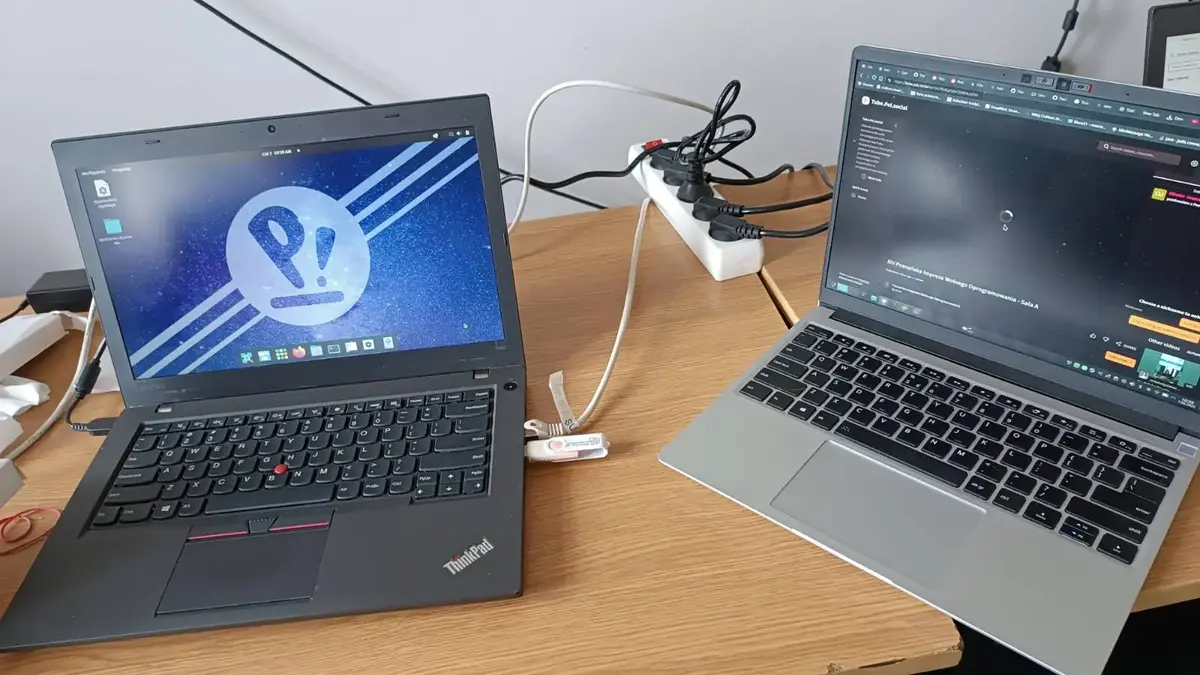
- 13Lead image: Laptopy wykorzystane na turnieju Poznańskiej Imprezy Wolnego Oprogramowania.webp · Karol Drzazga, via Wikimedia Commons (CC BY-SA 4.0) · Accessed 13 November 2026
House byline
Articles under this byline are researched and drafted with AI assistance, with every figure checked against its source before publication. The editor, Pankaj Guleria, reviews them and corrects them where needed.
Edited by Pankaj Guleria, Founder and Editor